Romsdalen
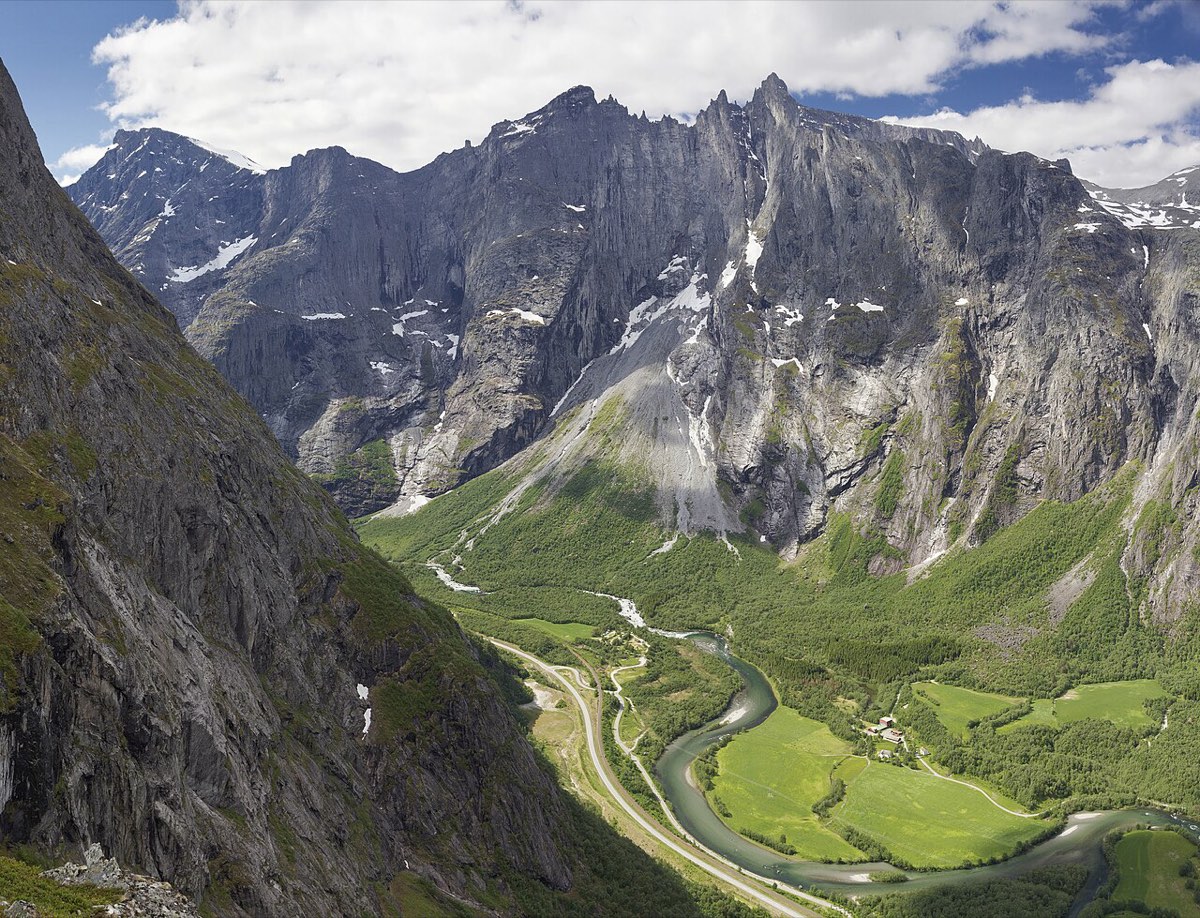
The valley runs inland from Åndalsnes between walls that rise about 1,500 m on both sides. On the north flank the Trolltindene ridge ends in Trollveggen, the Troll Wall, which drops roughly 1,100 m from the summit plateau of Store Trolltind and overhangs its own base by about 50 m near the top. It is the tallest vertical rock face in Europe.
The wall was climbed twice in the same week of July 1965, by a Norwegian team and an English one working independent lines. The rock is poor on the lower half, a fractured gneiss that sheds constantly, and most of the early routes involved long sections of aid. A major collapse in 1998 removed several of them permanently. Winter ascents, which freeze the face together, are now the preferred approach.
Trollveggen was a BASE jumping site through the early 1980s until a run of fatalities led to a ban in 1986. It remains in force.
Across the valley, Romsdalshorn is the better-known summit and the older ascent. Two local farmers, Christen Hoel and Hans Bjermeland, climbed it in 1827, thirty-eight years before the Matterhorn. Nobody believed them, so they repeated the climb and lit a fire on top where the village could see it.
Lofoten and Senja
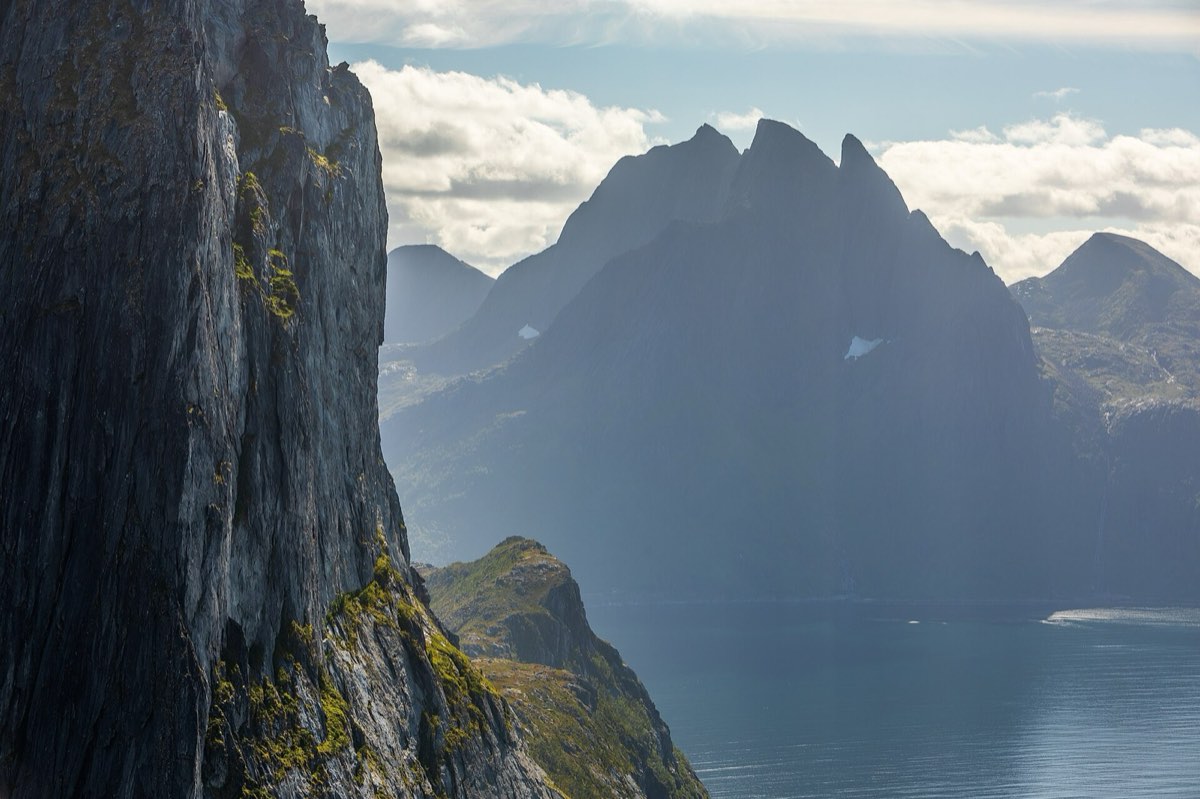
The Lofoten archipelago sits above the Arctic Circle and the rock is some of the best granite in Europe. Routes start at the tideline, which means the approach is a walk along a beach and the descent is a walk back to it. Under the midnight sun between late May and mid-July there is no darkness at all, and parties routinely start a long route at nine in the evening to avoid the afternoon crowds.
The drawback is weather. Lofoten sits in the path of North Atlantic depressions and the rock is slow to dry. A settled week is a good week.
Senja, further north, is less developed and less visited. Segla is its signature feature: a 639 m summit whose north side falls about 300 m straight into Mefjorden. The walk-up from Fjordgård is a marked trail, but the photograph everyone recognises is taken from the Hesten ridge opposite rather than from Segla itself.
Stetind, 180 km further east in Tysfjord, is a different proposition: a granite obelisk with no easy side. It was voted Norway's national mountain in 2002.
Jotunheimen
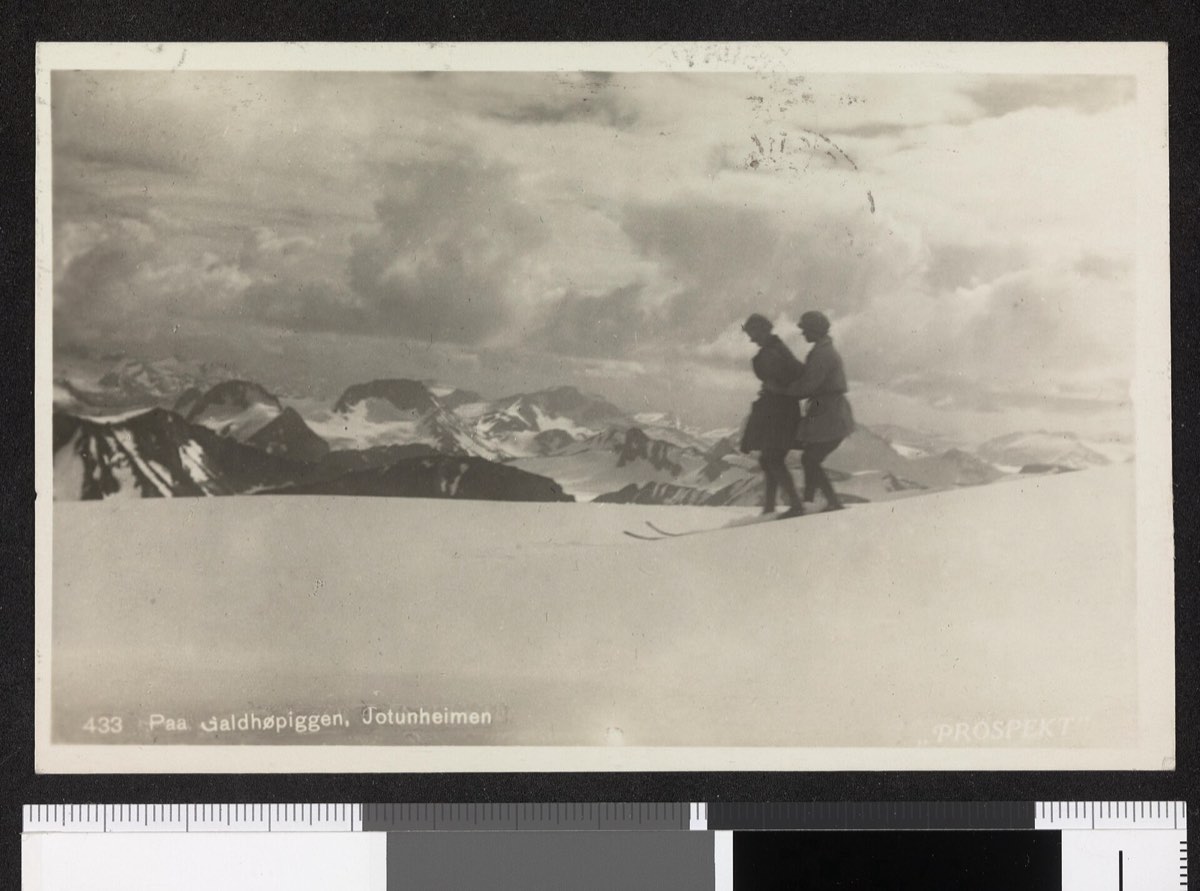
The high interior. Galdhøpiggen at 2,469 m is the highest point in Northern Europe, and the standard route from Juvasshytta crosses the crevassed Styggebrean glacier, so parties go roped and with a guide. The alternative from Spiterstulen stays on rock and scree the whole way and needs no glacier equipment, which is why most walkers use it.
The Hurrungane subrange to the west is the sharper ground. Store Skagastølstind, Storen, was soloed in 1876 by William Cecil Slingsby after his two Norwegian companions turned back at the col. He was twenty-seven and had no rope above that point. The ascent is generally taken as the start of Norwegian alpinism, and Slingsby is still referred to locally as its father.
Season. Rock in Lofoten and Senja comes into condition from late May and stays until early September, with July the most reliable month. Romsdalen's big walls are better in winter, February to April, when the face is frozen and the rockfall stops. Jotunheimen's glacier routes run from late June to mid-September. See the seasons page for the full comparison.
Norwegian entries in the register
| Peak | Elevation | Prominence | Range | First ascent |
|---|---|---|---|---|
| Galdhøpiggen | 2,469 m | 2,372 m | Jotunheimen | 1850 · Steinar Sulheim, Lars Arnesen, Ingebrigt Flotten |
| Store SkagastølstindStoren | 2,405 m | 895 m | Hurrungane | 1876 · William Cecil Slingsby |
| Stetind | 1,392 m | 1,261 m | Tysfjord | 1910 · Ferdinand Schjelderup, Carl Wilhelm Rubenson, Alf Bonnevie Bryn |
| Store TrolltindTrollveggen · Troll Wall | 1,788 m | 270 m | Romsdalen | 1965 · Leif Normann Patterson, Odd Eliassen, Jon Teigland, Ole Daniel Enersen |
| Romsdalshorn | 1,550 m | 565 m | Romsdalen | 1827 · Christen Hoel, Hans Bjermeland |
| Segla | 639 m | 445 m | Senja | — |